
Cozy Areas & Big Feelings: Growing Emotional Skills in the Classroom
Emotional Development
Emotional development is the process by which young children learn to recognize, understand, and manage their feelings in healthy ways. It’s a crucial part of building relationships and developing self-control. This foundational skill is vital for a child’s future academic success, mental health, and social well-being.
Teaching Emotions
Teaching emotions to young children can be done in various engaging ways, including using books and visual aids, modeling positive social behaviors, and identifying special cozy areas in the classroom.
Using Books to Teach Emotions
During story time, teachers choose books that feature characters dealing with different emotions and social situations. As teachers read books to children, they often have them guess how the characters in the story feel and ask open-ended questions such as, “How can you tell that the character is feeling that way?” Teachers often use books to introduce a new social or emotional skill. If a teacher notices children having trouble sharing toys or materials, they may read the Rainbow Fish, by Marcus Pfister, aloud and then discuss ways to share with others. Check out our teacher-approved book list below!

CSCC Director
Children’s Books for Teaching Social and Emotional Skills
- Can You Be a Friend?, by Nita Everly
- Care Bears Caring Contest, by Nancy Parent, illus. by David Stein
- Fox Makes Friends, by Adam Relf
- How Do Dinosaurs Play with Their Friends?, by Jane Yolen and Mark Teague
- How I Feel Frustrated, by Marcia Leonard
- I Can Do It Myself (a Sesame Street Series), by Emily Perl Kingsley, illus. by Richard Brown
- I’m in Charge of Me!, by David Parker, illus. by Sylvia Walker
- Mouse Was Mad, by Linda Urban, illus. by Henry Cole
- My Many Colored Days, by Dr. Seuss, illus. by Steve Johnson and Lou Fancher
- Sharing: How Kindness Grows, by Fran Shaw, illus. by Miki Sakamoto
- When I’m Feeling Sad, by Trace Moroney
- When Sophie Gets Angry—Really, Really Angry, by Molly Bang
Visual Aids
Visual aids such as feelings posters help children recognize, name emotions and develop emotional literacy and regulation skills. They serve as a bridge for communication before preschoolers have the verbal skills to express their complex emotions. Feelings posters are usually posted in the “cozy area” of the classroom.
Modeling Positive Social Behaviors
Children learn social behaviors by watching the people around them. This is why it’s so important for teachers to model appropriate behavior and language.
By demonstrating respectful and kind behavior, teachers show children how to interact with others and express their emotions. Using simple phrases like, “walking feet, please,” and “use gentle hands,” helps set clear expectations. These gentle reminders help children learn social and emotional skills in the moment and throughout the day.
Teachers promote children’s social and emotional health by establishing trusting relationships, created when teachers express warmth, affection, and respect. Teachers can intentionally teach and enhance these skills using evidence-based strategies to teach, model, and reinforce positive behaviors. As evidenced in the preschool classrooms we observed, teachers who prioritize developing children’s social and emotional health are richly rewarded with happy, engaged children who learn to avoid and resolve conflicts, share and take turns, and express their emotions in productive ways.
Cozy Area
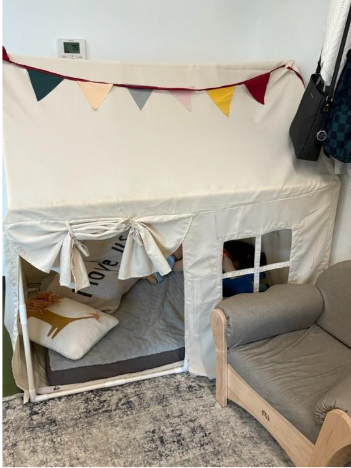
Supporting children with identifying and expressing their emotions daily is one of our top priorities at the children’s centers. Now that we have started a new school year, this is extremely important so that children feel loved and safe when dropped off at school. One strategy is introducing the “cozy area” with in the first 30 days of school. The designated “cozy areas” for children help them learn to manage their emotions, build healthy relationships, and feel confident enough to explore, learn and grow. It’s often set up in a corner or a nook to provide a sense of privacy, yet it remains visible to teachers. This setup allows children the space they need to work through their feelings while still being supervised.
Cozy areas are built with a child’s comfort in mind and are large enough for only one or two children at a time. They typically include:
- Soft furniture like beanbags, pillows, or blankets.
- Cuddly items such as stuffed animals.
- Sensory objects like stress balls or squeeze toys to help children who are feeling angry or frustrated.
- “Feeling posters” that help children identify and talk about their emotions.
Please mark your calendar for our upcoming events!
September 16: Family Power Hour
September 25: Picnic on the playground
October 15-17: Fall Pictures